Sunday, November 2, 2008
Finally!
So what finally got the Nitrates to drop?
1. Reduced feeding to once per day. I have been doing this for months so probably not too likely.
2. Deep sand bed. The deep sand bed was installed the first week of August. Does it really take three months to cycle?
3. Chaeto algae in fuge. Hmm. It's only been in there for about a month.
4. The lighting in the fuge. The lighting is causing algae to grow on the glass. All of the algae is full of bubbles. Could this be nitrogen? Also now seeing some bubbles in the sand. I saw this earlier when I was keeping the fuge lit. The bubbles went away when I stopped illuminating the fuge.
5. The lighting upgrade for the main tank. Can there be a relationship?
My Frogspawn, Xenia and mushrooms are doing very well. My Xenia keeps splitting on its own. I now have about 4 stalks on both sides of the tank. They pulse like crazy even with current flowing across them. My open brain has not been opened for months. I'm hoping that the combination of improved lighting and lower nitrates entice it to open soon.
Spawn or Just a Burp?
| From Paul's Reef |
I noticed this last night as I was observing my tank. The 12000K fluorescents had turned off about half an hour earlier and just the actinics were on. By chance I happened to look at the tooth coral and saw it let go of the cloud. Before it let it go it looked like there was some material hanging out of the mouth. Afterwards, the polyp shrunk down a bit.
New Lights
I replaced the right half only and did a comparison. There is no comparison between the old and the new. The old 12000K bulb was much more yellow than the new bulb. The old actinic was much dimmer and so much less purple than the new. I replaced the other half and reset the timers to reduce the on time to avoid shocking and bleaching the coral by changing the light intensity too quickly.
I know have 4 timers. The bulbs are turned on and off at different times to try to replicate the changing light intensity throughout the day.
Timer 1 - Actinics - On 9:00 am, Off 9:00 pm
Timer 2 - 12000Ks - On 10:00 am, Off 8:00 pm
Timer 3 - 6500Ks - On 12:00 pm, Off 4:00 pm
Timer 4 - Fuge 6500k - On 6:00 pm - Off 9:00 am reverse light cycle.
Monday, October 20, 2008
Freebies
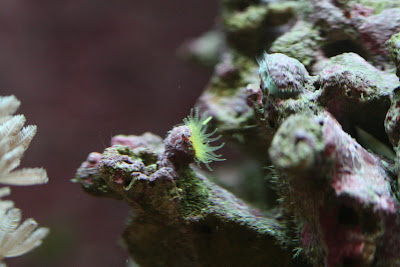
The first is some sort of a yellow polyp. It prefers to open up after dark but sometimes it opens when the lights are on. It is really small, about the size of a pencil eraser.
| From Paul's Reef |
The next one is significantly larger; about an inch by an inch. I', not sure what it is, however, it does not appear to be aptasia.
| From Paul's Reef |
| From Paul's Reef |
It has grown since I inherited it but it is not a super fast grower. Hopefully it is nothing too nasty.
Wednesday, October 8, 2008
Where have I been?
What's my excuse?
a. It's been summer
b. Lots of stuff going on at home.
c. Busy at work.
d. Cat ruined my camera by peeing on it.
e. All of the above.
If you answered "e" you are correct. Yes one of our cats, I mean former cats, micturated on our Canon Rebel XTi digital SLR. My wife found it sitting in a pool of urine on our kitchen counter. I had to take the camera completely apart and clean it with alcohol and Q tips. Miraculously it still works. Both cats have been returned to the No Kill shelter where we got them.
So, what's been happening lately in my tank?
First, I completed my refugium with a deep sand bed. The largest size tank I could get in my stand was 10 gallons. Way too small for what I wanted so I used two of them. They are connected using 2" PVC pipe. I drilled holes in the tanks and used bulkheads to connect them.
The left tank contains the deep sand bed (DSB). It contains 30 lbs of sugar size Oolite sand and 40 lbs of live Caribbean reef sand mixed together. I also moved a few cups of sand from my main tank into the DSB.
| From Paul's Reef |
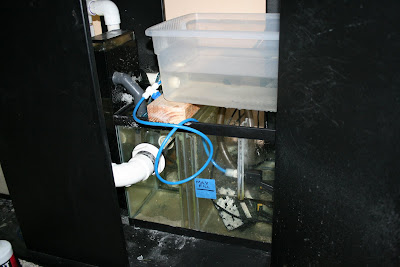
The right side houses my protein skimmer, auto top off system, sump and return pumps.
| From Paul's Reef |
The water flows down from my main tank into my refugium. I use a valve to control how much water flows into the deep sand bed (left tank) and how much flows into the right tank. The theory is that you don't want too much flow through the DSB. I have about half the flow going through the DSB.
In the right tank I used a piece of acrylic to construct a chamber. The height of this wall sets the height of the water in both the chamber and DSB portion of the tank. I built the chamber large enough to house a bigger protein skimmer. For now I'm using my hang on the back Remora skimmer. It used to hang from the back of the main tank but has now been moved under the stand.
I have two additional dividers used to implement a bubble trap. The middle wall does not make contact with the bottom of the tank. This forces the water to flow down and then up on the other side of the center divider. Once the water flows over the right-most divider it is in the sump.
The sump now houses my heater and and two 802 power heads. I had these laying around so I used these instead of buying a "real pump". These power heads move a lot of water. They are rated for 400 gph with no head pressure. However, the flow pumping up 4 feet. I believe the flow is reduced roughly but I haven't measured it. Therefore, with my two pumps I am getting about 400 gph total. To use these you just have to shove plastic tubing over the exit orfice. Be sure the hose covers the venturi opening. My two pumps are slightly different. One of them has the venturi opening elevated so I can't shove the plastic hose over it. Instead I found an air stone that fits perfectly in the hole to block the flow.
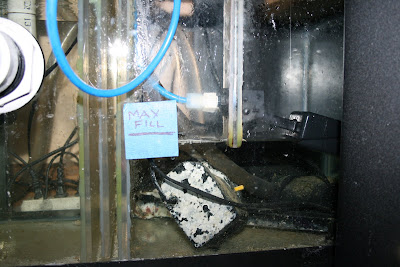
Note the max fill line on the sump. If the sump is filled above this level and the power goes out I'll flood my family room. I drilled holes in the return pipes into the tank just above the water line to break the siphon when the power goes out.
Finally, I constructed a top off system using a Coralife float valve and plastic storage container and some fittings from Home Depot and Ace hardware. This works perfectly keeping the water level constant in the sump. I just need to remember to refil the fresh water reservoir with RO water every few days.
| From Paul's Reef |
I purchased and overflow box and constructed a Hofer Gurgle Buster to virtually eliminate all noise in the overflow box. It works really well and was simple to build.
| From Paul's Reef |
| From Paul's Reef |
The sand went in the tank on 8/2/2008. It is now 10/8/08, more than 2 months later. So after all of this have my nitrates gone down?
Nope.
Nitrates are still fluctuating between 25 and 50ppm as measured with my Salifert kit.
So now what? I purchased some Chaeto algae to put in the DSB side of the tank. Hopefully, the algae will absorb nitrate and reduce the level.
One final note. I chose to have water from the DSB / refugium flow into the chamber containing the protein skimmer. Many recommend against this because many of the copepods will get skimmed out. I did it because it made for a simpler design that maximized my water volume and reduced plumbing and pump requirements. I can tell you that after I added my DSB and sump I experienced a copepod bloom in my main tank. These "bugs" are crawling/swimming all over my live rock. I haven't seen any copepod corpses in the skimate.
Monday, July 21, 2008
If one sump is good...
Plan B
I need to do this as inexpensively as possible so I'm not buy a pre-made acrylic sump nor am I going to take the time to custom make an acrylic sump that will just fit into the stand. The largest tank I can place into the stand turns out to be 10 gallons. I feel that a 10 gallon tank is too small. Once I add the deep sand bed and allow room for the water to rise in a power failure there won't be enough water volume in the tank. So, I'll use two tanks. It so happens that I have two of these already.
I will connect the two tanks together with PVC plumbing and bulkheads to allow the water to flow between them. One tank will have a deep sand bed and will serve as the refugium. The other tank will house the protein skimmer, sump and return pump. Water from my overflow box will flow into both tanks and I'll use valves to set the flow through the refugium. The output of the refugium will flow into the chamber that houses the protein skimmer in the second tank. A baffle will set the water level for the protein skimmer and refugium. Water from the overflow box that didn't go directly into the refugium will flow into the skimmer chamber. A set of baffles will eliminate bubbles as the water flows into the sump that houses the return pump. I'm also going to add a Durso Standpipe to my overflow box to cut down on noise. I am also going to add a float valve in the sump to handle automatic top offs. I'll post a set of plans soon and pictures when I complete it.
I can't wait to get started on this. My nitrates are still high and I need to do something soon. I'm losing my tongue coral. My glass hole saw and bulkheads are on order from glass-holes.com. Creative name, huh?
Tuesday, July 15, 2008
Vacation
I also purchased a PF-800 overflow box and 40 pounds of live sand while there. These will be used for a refugium I'll be building out of an old fish tank in the base of my stand. I'm still undecided as to whether or not I'll add macro algae. I'll probably see if the live sand alone will reduce the nitrates.